
October 21, 2026 · Quartz Epoxy Pro
Epoxy or regular paint for a garage floor: which one holds up?
For a garage floor you drive and park on, use a true two part epoxy, not regular paint. Paint is a thin film that tends to lift under tires and soak up oil and stains, while two part epoxy cures chemically into a hard, thick coating. Paint costs less up front, but it is the wrong tool for a floor that takes real traffic.
The catch: a lot of products sold as "epoxy paint" are not the same thing as a two part epoxy system. Here is how to tell them apart.
What regular floor paint does
Regular paint, including most porch and floor paint, dries as its liquid evaporates. What is left is a thin film sitting on top of the concrete. On a wall that is fine. On a garage floor it has a tough job:
- Tires. Hot tires coming off the road can soften a thin film and pull it up, especially in Arizona summers. Once it starts lifting, it keeps going.
- Stains. Oil, fluids and road grime can work into a thin film and leave marks that will not scrub out.
- Wear. Grit, dragged tools and foot traffic wear through a thin coat, and bare concrete starts showing in the lanes you use most.
What true two part epoxy does
A two part epoxy comes as two components: a resin (Part A) and a hardener (Part B). When you mix them, a chemical reaction starts and the material cures into a hard, solid coating. It does not just dry. That is why you have a working window. With our kits, pot life is 20 to 30 minutes after mixing begins, and you mix with a drill and paddle for 3 to 5 minutes, never by hand.
Our indoor quartz sand epoxy self leveling kit is a two part bisphenol A epoxy with quartz sand aggregate. Each kit covers 100 square feet at a target thickness of about one eighth inch. That is a real coating with body to it, not a film you can scratch through with a fingernail.
Once it cures, it handles traffic on a clear schedule: light foot traffic after 24 hours, full cure at 72 hours, driving after about 5 days, and water exposure after 7 days.
One part "epoxy paint" vs two part systems
This is where people get confused, and it is not their fault. Some products on the shelf say epoxy on the label but come in a single can with nothing to mix. Those are generally paints with some epoxy added. They go on like paint, dry like paint and behave much more like paint than like a cured epoxy coating.
A quick way to tell what you are buying:
- One container, no hardener: it is a paint, whatever the label says.
- Two components you must mix, with a stated mix ratio and pot life: it is a two part system that cures chemically.
- Check the label and safety data sheet. A real two part system lists both parts and how to combine them. Our SDS sheets are posted at our safety data page.
One part products are cheaper and easier to apply, but for a floor that holds up to cars they are a step above paint at best.
What quartz aggregate adds
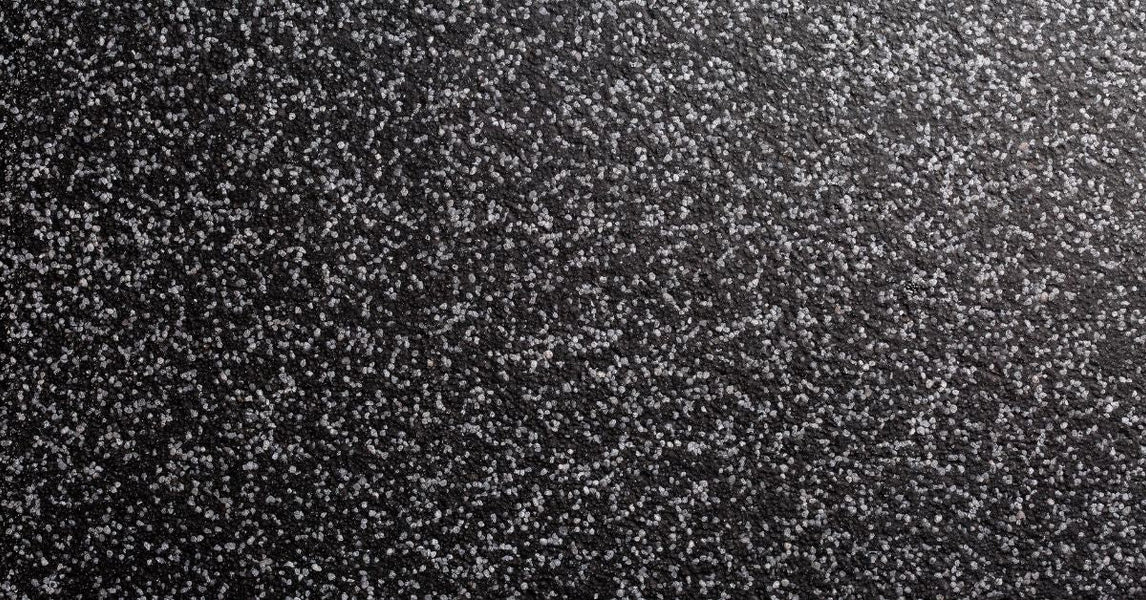
A plain epoxy coating is hard, but it can be smooth and slick. Our system adds quartz sand aggregate, which brings three things paint cannot:
- Thickness. The aggregate builds the coating up into a solid layer.
- Texture. A stone look instead of a flat painted look. If you are comparing styles, our post on quartz epoxy vs flake floors explains the difference.
- Grip. Factory testing lists a slip coefficient of 0.4 or higher. Slip resistance still varies with how evenly the aggregate is spread, contaminants on the floor and wet conditions.
Prep matters for both
Paint or epoxy, nothing sticks to dirty, sealed or glossy concrete. Our installation guide states that about 95% of epoxy failures trace back to inadequate surface prep. That means sweeping and vacuuming, degreasing oil spots, rinsing and drying fully, filling cracks, then grinding the whole floor to a texture like 60 grit sandpaper and vacuuming every bit of dust.
Try the water droplet test first. Sprinkle water on the floor. If it soaks in within about 30 seconds, the surface can take a coating. If it beads up, there is a sealer or contaminant that has to come off. Our post on grinding vs acid etching covers why grinding gives the best bond, and the full steps are in our installation guide.
If the floor already has paint on it, grind it off down to bare concrete. A new coating can only hold as well as the layer under it, and paint is only as strong as its bond to the slab. Primer, sold separately, is strongly recommended over previously painted or sealed floors.
The honest cost comparison
Paint is cheaper up front. Here is what epoxy runs for a typical 2 car garage of about 400 square feet:
- Do it yourself with our kits: 4 indoor kits at $249 each in Marble Grey or Desert Grey is $996. In Black at $300 each, it is $1,200.
- Tools: about $95 for the squeegee, defoaming roller and extension pole if you do not own them. Our epoxy tool kit at $125 adds a tool bag, spiked shoes and five application and finishing trowels.
- Primer: extra if your floor needs it.
- Pro install: national pricing is often quoted around $4 to $10 per square foot, roughly $1,600 to $4,000 for the same garage.
The real question is not what each costs on day one. It is how often you want to redo it. A paint job that lifts in the tire lanes means scraping and repainting. A properly prepped two part epoxy floor is a one time job you maintain with a dust mop and a pH neutral cleaner. See what it costs to epoxy a two car garage for more. A typical do it yourself job is a weekend: prep and prime day one, pour day two.
When paint is good enough
Paint can make sense for a storage room you never drive into, a shed floor with light foot traffic, or a quick cosmetic fix on a floor you plan to redo later.
For outdoor slabs in direct sun, neither paint nor our indoor kit is the answer. Bisphenol A epoxy can amber in direct sunlight, so the indoor kit is not for patios, driveways or pool decks. Use our outdoor washed stone quartz epoxy kit at $229 instead.
Still deciding if this is a job you can handle? Read can you epoxy your own garage floor, or browse our city planning guides for local tips. We ship nationwide, and Phoenix area customers can pick up at our Queen Creek shop with no freight charge.
Quick answers
Is epoxy better than paint for a garage floor?
For a floor you park on, yes. Paint is a thin film that tends to lift under tires and soak up stains. Two part epoxy cures chemically into a hard coating that stands up to traffic and cleans up easily.
Is one part epoxy paint the same as a two part epoxy system?
No. A one can product that never needs a hardener mixed in is a paint with epoxy added, and it dries like a paint. A true two part system mixes a resin with a hardener and cures chemically into a much harder coating.
Does epoxy cost more than paint?
Yes, up front. A 2 car garage of about 400 square feet takes 4 of our indoor kits, which is $996 in grey or $1,200 in Black, plus tools and primer if needed. Pro installs are often quoted around $1,600 to $4,000 for the same space.
Can I put epoxy over a painted garage floor?
Not directly. Paint is only as strong as its bond to the concrete, so grind it off down to bare concrete first. Primer is strongly recommended on floors that were previously painted or sealed.
Skip the paint and do it once
A true two part quartz epoxy floor costs more than paint up front and holds up far better under tires. Call us with your square footage and we will help you plan it.